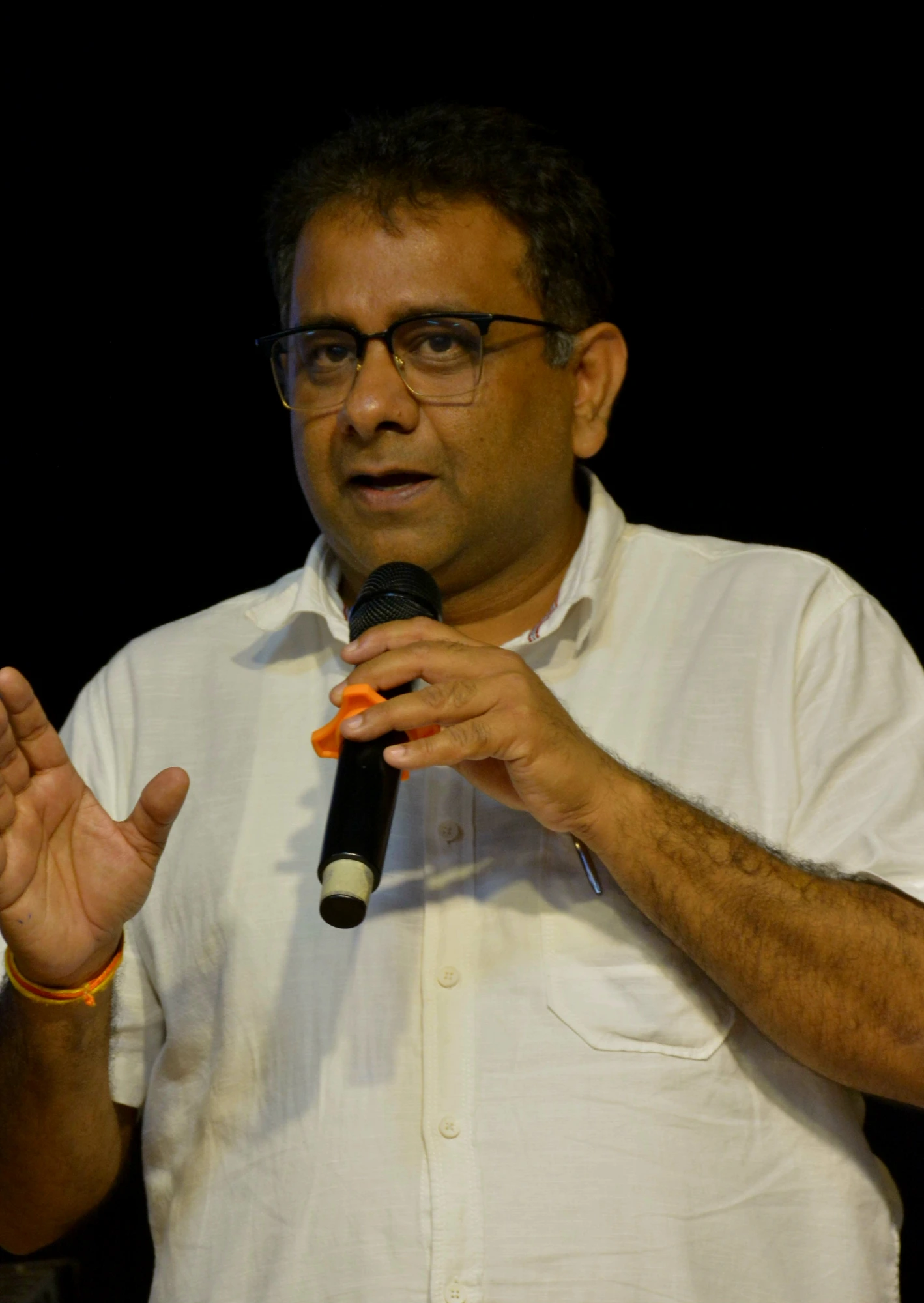
Rajeev
Singh.
Rajeev Singh is Professor at the Department of Chemistry at Atma Ram Sanatan Dharma College, University of Delhi. He is an inorganic chemist with research specialization in Material Chemistry and Organometallics. He completed his Ph.D. from the University of Delhi and served as a TWAS postdoctoral fellow in Brazil. His other academic interests are the revival, communication, and awareness of ancient Indian sciences and the contributions of Indian scientists.
Prof. Rajeev Singh is listed among the World’s Top 2% Scientists — the global ranking compiled by researchers at Stanford University and Elsevier from Scopus citation metrics.
View TOPSCINET profileA scholar with an international footprint.
Nominations, fellowships and honours that place Prof. Singh's work on the world stage — from Stanford's Top 2% Scientists list to a TWAS Postdoctoral Fellowship in Brazil.
The World Academy of Sciences · Universidade Federal do ABC, Brazil.
Selected among India's promising early-career chemists.
Translated by CSIR–NIScPR into every constitutional language of India.
Serves review panels for leading international chemistry publishers.
His home institution and alma mater, the international labs where he has held fellowships, and the national bodies he works with.
 Atma Ram Sanatan Dharma CollegeUniversity of Delhi
 University of DelhiNew Delhi, India
 Hindu CollegeAlma mater · Delhi
 Universidade Federal do CearáFortaleza, Brazil
 Ministry of MSMEGovernment of India
 Ministry of CultureGovernment of India
 Vijnana BharatiVIBHA · India
 Vaigyanik ChaiScience outreach forum
- The World Academy of SciencesTrieste, Italy
- Japan Advanced Institute of Science & TechnologyNomi, Japan
The lab, the classroom & the world.
A working professor’s website — organised into six spaces you can dip into.


Each pulsing point is a country whose readers, researchers or students have opened this site. Click any dot to see the posts and lectures that audience reads most.
Interested in a collaboration or a Ph.D. position?
Prof. Singh welcomes enquiries from researchers, students, science communicators and journalists. The fastest way to reach the lab is by email.